
The Land Decides
An estate that measures its own recovery has a problem: measured against what? A number improves, and nobody can say whether that was the farming or the weather.
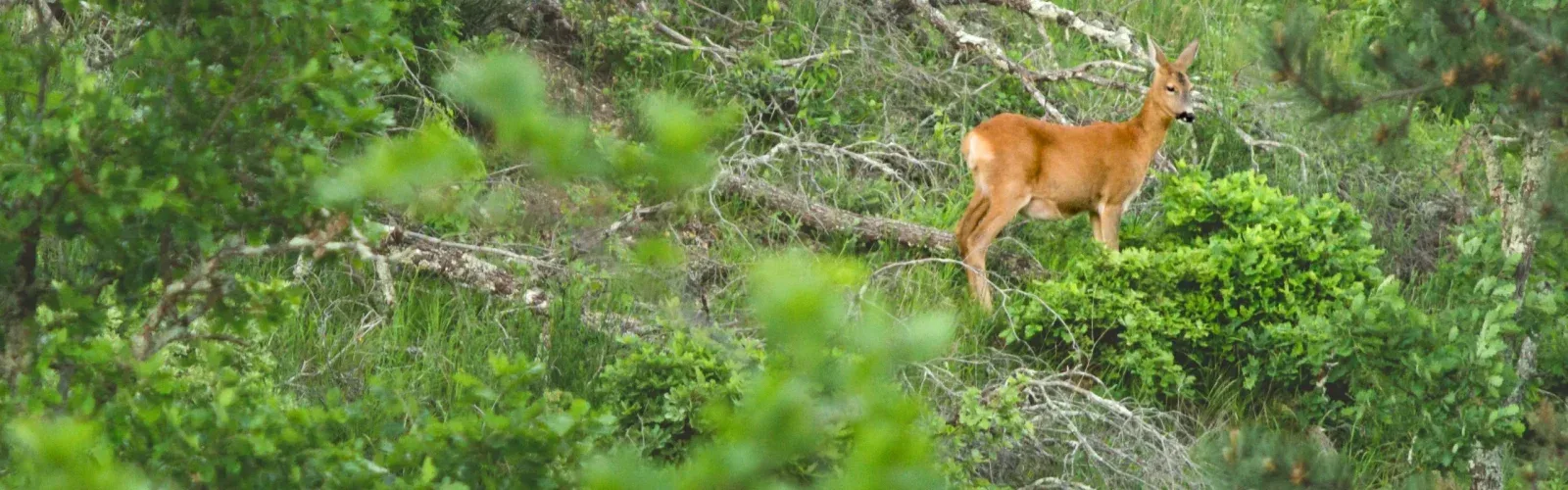
These sixteen hectares answer it. Left to itself, land does not go quiet. It arranges. Water finds its old channels, species arrive in an order no one planned, and a corridor of wild life knits itself across the ground.
Whatever happens there is the baseline. When carbon rises in the farmed soil, we can see whether it rose faster or slower than on ground nobody touched. When a species returns, we know whether it came because of us or in spite of us. Without the wild half, the other half is only a story.
There is a complication, and the science has moved recently. Open ground in the Mediterranean was held open for thousands of years by grazing, first by wild herbivores and later by sheep and goats. Where that grazing stops, the land closes into scrub, and Mediterranean scrub burns. In Portugal, free-roaming herds are now used as fire management for precisely this reason.
Fire is the argument everyone knows. The better one was published in July 2026, out of the Knepp Estate in Sussex and the University of Oxford. Over three winters a research team lifted 270 scrub trees whole from the ground, roots and all, to find out what browsing does below the surface.
Browsing does not simply hold a plant down. It sends the plant’s carbon downward, into thorny, many-stemmed, root-heavy growth. The team measured more mass below ground than above it, against a quarter of that in the models carbon accounting normally uses. Roots break down slowly, so what browsing puts there stays.
The work began in the wood pastures of Crete, where oaks shaped by centuries of goat and sheep browsing grow low, thorny and deep-rooted. That is Mediterranean ground, and it is nearer to this hillside than any plantation model. What those equations do not give us is a number for Orsina. Species and context change the answer, which is why we measure our own.
What we can do is ask people who know this ground better than we do. Sheep, goats and chickens are decided, and horses come first. Whether large cattle belong here, and at what number, is the open question.
We have spent time with the grey Maremmana and with the Butteri who have kept the breed for generations, asking what a herd of that weight would mean across seventy hectares. The decision is not ours alone to make. It is the land’s.
The Blockchain Accountability Ledger will hold the record. A single stay will be traceable to the hectares it helped keep wild.